

A Faster Path to Starting Your Tijuana Operation

Instead of waiting months for overseas shipments or navigating congested global supply chains, a growing number of manufacturers are looking at a different equation: producing within driving distance of the U.S. market. In that shift, Tijuana has emerged as one of the busiest industrial gateways in North America, where factories, logistics providers, and cross-border operations function as part of a tightly connected regional manufacturing network.
The city’s location next to California, combined with its mature industrial ecosystem and export manufacturing experience, has turned it into a strategic launch point for companies seeking speed, flexibility, and closer integration with U.S. customers.
Tijuana’s manufacturing ecosystem has evolved significantly over the last decade. The city is now home to major aerospace, electronics, automotive, and medical device operations, as well as emerging industries.
For many companies entering Mexico for the first time, the biggest challenge is not finding customers or transferring production equipment. It is navigating the operational structure required to legally manufacture, hire workers, import raw materials, and export finished products within a short timeframe.
Traditionally, establishing a manufacturing operation in Mexico could take several months or even more than a year, particularly for companies unfamiliar with Mexican labor law, tax registration, customs regulations, environmental requirements, and IMMEX compliance. The shelter manufacturing model was designed to significantly compress that timeline.
The concept of launching a manufacturing operation in approximately 90 days is largely tied to Mexico’s shelter manufacturing model. Under this structure, a foreign company can begin operations without immediately establishing a standalone Mexican legal entity.
Instead, the shelter provider acts as the legal entity of record in Mexico while the client company focuses on production, quality control, engineering, and customer relationships. Administrative functions are handled by the shelter operator.
Leveraging the Shelter Model to Start Operations in Tijuana
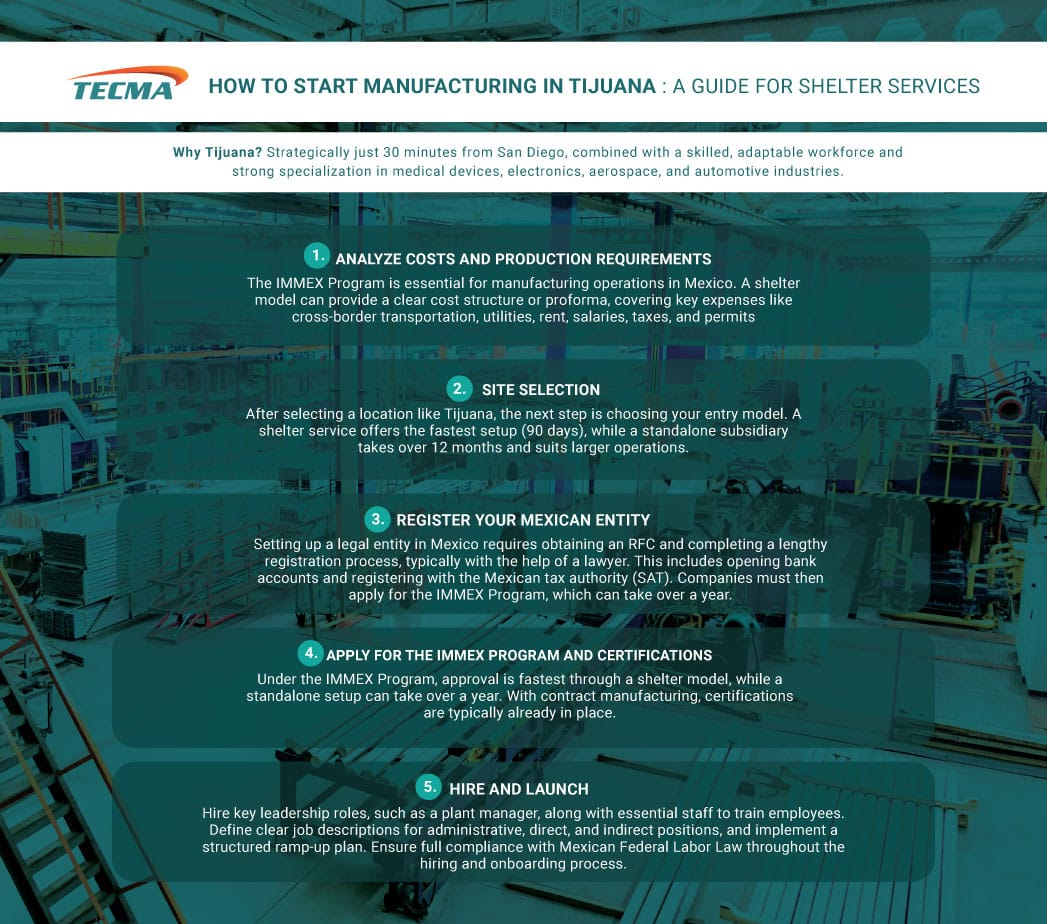
Tecma’s expertise can help you become fully functional in Tijuana within 30 to 90 days, depending on the project scope and facility readiness.
The process typically begins with a cost and feasibility assessment. Companies evaluate labor needs, utility requirements, logistics costs, production volumes, and supply chain considerations. During this phase, manufacturers also analyze whether they require greenfield space, existing industrial facilities, or temporary startup capacity.
Once the operational model is defined, site selection becomes one of the most critical steps. Industrial availability in Tijuana can fluctuate depending on market conditions, particularly in high-demand sectors such as medical devices and electronics. Shelter providers frequently assist manufacturers by identifying available industrial buildings that meet production specifications, power requirements, and customs accessibility.
At the same time, workforce recruitment often begins before the equipment arrives. Providers such as Tecma offer recruiting and human resources support to identify production operators, technicians, engineers, supervisors, and administrative personnel. This allows manufacturers to begin onboarding and training workers while facilities are being prepared.
Navigating Tijuana Manufacturing Logistics and Workforce Recruitment
Import-export compliance is another major component compressed within the 90-day framework. Mexico’s IMMEX program allows manufacturers to temporarily import raw materials and production equipment without paying certain taxes and duties, provided finished goods are exported. Managing IMMEX registration, customs documentation, tariff classifications, and cross-border compliance can significantly delay independent market entry if companies attempt to handle these processes internally during the initial phase.
Integrated service providers frequently manage these functions directly, including customs brokerage, freight coordination, warehousing, and transportation logistics.
Equipment transfer and installation often occur simultaneously with workforce training and production line setup. Depending on the complexity of the manufacturing process, some companies begin with pilot production or partial line activation before scaling to full operations.
Operational readiness also requires compliance with Mexican labor regulations, payroll administration, tax reporting, environmental permits, and occupational safety standards. Shelter providers typically assume responsibility for these administrative areas, allowing manufacturers to focus on production efficiency rather than local regulatory management.
The ability to launch operations within approximately 90 days has become increasingly attractive as companies attempt to reduce dependence on long-distance Asian supply chains and shorten delivery timelines to U.S. customers.
Don’t let regulatory bottlenecks delay your nearshoring strategy. Set up a consultation with one of our cross-border experts today to map out your custom 90-day launch roadmap.